


Ever since Student Conduct Liaison Julie Corzine’s last furry companion passed away, there has been a chihuahua shaped hole in her heart. When she set her eyes upon Lacey Grace in the San Jose Animal Shelter, she knew it would be filled.
“The next day she was wearing clothes and sleeping on my chest,” Corzine said. “I’m like,‘you’re a foster, you’re a foster.’ But as far as foster failure goes, she ain’t going back. She’s mine.”
Almost a year after former Los Altos High School golf cart dog Dixie passed away, Corzine saw a facebook post about 22 stray dogs that had been found in San Jose. When she visited them at the nearby shelter, she saw Lacey Grace with another couple. Tail bent between her legs, Corzine said Lacey Grace wouldn’t look away from her — even across the holding run. Two weeks later Corzine returned to fill out the foster papers.
“ If anybody has had that closeness before, then they know exactly what it is,” Corzine said. ”It’s almost like somebody to bounce ideas off of.”
Fellow animal lover and rescue mom, art teacher Christine An said at first glance, she could tell Corzine would be a foster failure. In animal rescue, the term “foster failure” is used to describe volunteers who become too attached to the cats and dogs they’d intended to foster temporarily, and find themselves unable to return them to the shelter.
Having adopted from San Jose Animal Shelter herself, An related to the special companionship of pets.
“When we love [animals] that much, fail proof, we bond so intensely,” An said. “Animal lovers like us have a very hard time letting go because they become our babies.”
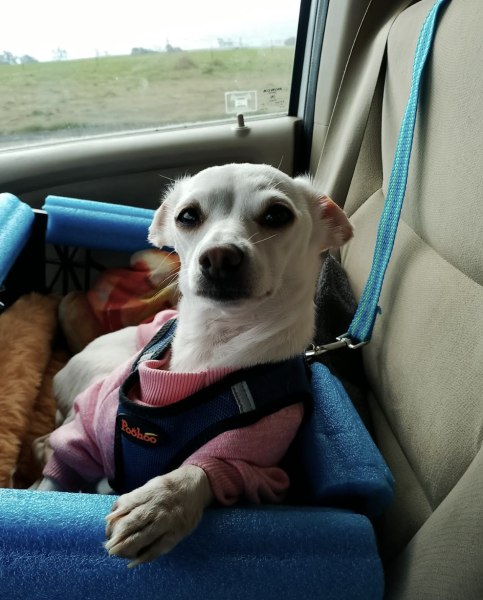
(Courtesy Julie Corzine)
Common with rescues, Lacey Grace’s story before the San Jose Animal Shelter is unknown. When Corzine first took her in for a check-up, the veterinarian noted that Lacey Grace was underweight. Later, Corzine noticed a lump in her paw and irritation in her ear.
Following her intuition, Corzine brought Lacey Grace to An, a certified veterinary assistant, who presumed the culprit was a foxtail lodged in both areas. Corzine later returned to the vet to get them removed.
“ I don’t know how these rescue dogs walk around with painful paws like that,” An said. “Maybe they’re trying to hide the pain and not show us that they’re hurt. But I’m just glad that [the vet] found it and was able to take it out.”
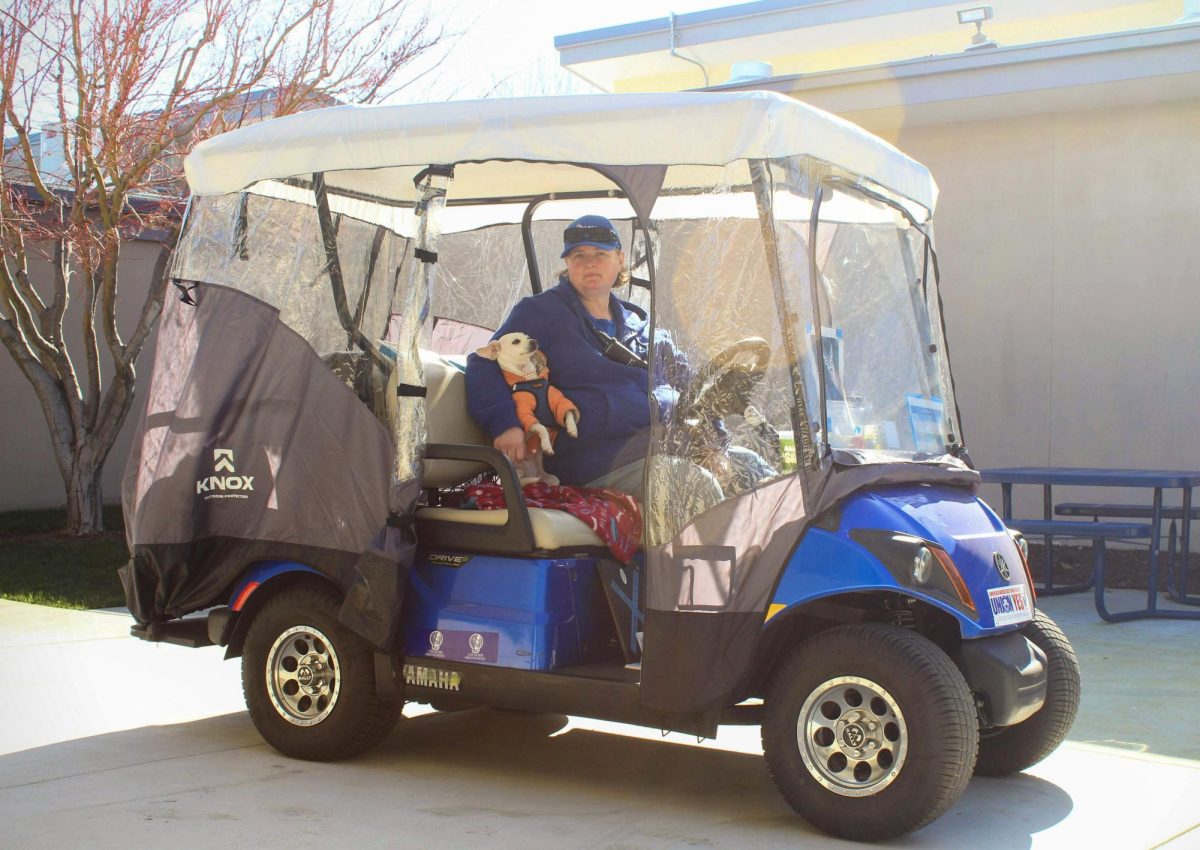
Outside a slough of health concerns, Lacey Grace struggled with what animal rescuers call FAS: fear, anxiety and stress. Corzine said Lacey Grace has grown into her personality but is still a timid dog, recounting how she was afraid of the elevators on campus at first. Now however, she’s settled into their routine, following Corzine around LAHS on daily tasks — sharing lunch breaks and changing outfits depending on the weather.
“ Sometimes students are off put with the fact that I’m campus security or Student Conduct Liaison,” Corzine said. “I think the dog helps bring them in because we share that common love for animals.”
Corzine’s last dog, Dixie, was with her for six years, the last three as LAHS’s resident golf cart dog. But she wasn’t the only pet Corzine brought to work with her. In her 20s, Corzine adopted her first dog — independent from family pets — and brought it to work at an impatient adolescent rehabilitation center in the Santa Cruz Mountains.
The process of bringing a pet on campus is different for every staff member. For Corzine, Lacey Grace is listed as an emotional support animal. After submitting a letter from her doctor to the district, she had an accommodation meeting to discuss the logistics of keeping Lacey Grace and students safe.
As far as upholding Dixie’s legacy, Corzine sees a lot of similarities between Lacey Grace and the late rescue mix.
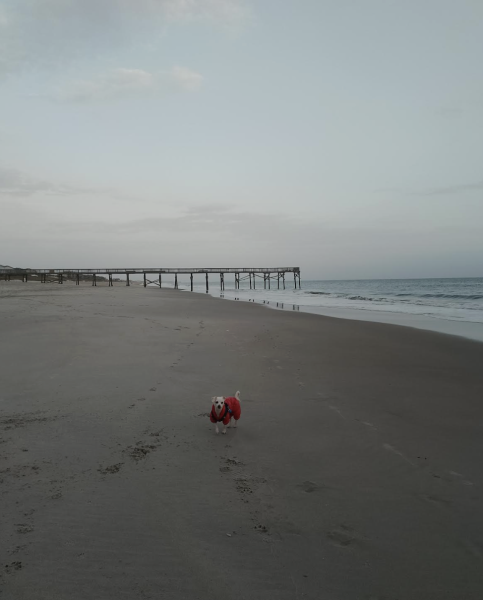
“ There have just been so many times where I felt like Dixie was talking to her, telling her how things go or what she should be doing,” Corzine said. “I get total Dixie vibes with her, but I’m trying to let her be her own dog”
Two months after being adopted, Corzine and Lacey Grace are rarely apart. Corzine said she often talks to Lacey Grace, and that usually she is understood.
“ She’s gotten a lot better about answering me back,” Corzine said.
It was when visiting family for the holidays in North Carolina, that Corzine said Lacey Grace found her voice. Lacey Grace does not bark often, but Corzine recounted a moment that trip when she continually barked at the dogs play-fighting around her. Accordingly, Corzine dubbed her the “ref.”
Lacey Grace sits in the passenger seat of Corzine’s golf cart, adorned in a rose gold bodysuit — glossy eyed and staring at Corzine just as she did on the day they met. Only when Corzine calls to her, does she stand up, wagging furiously.
“The shelter may be better than where they came from but there’s no place like a real, loving home,” Corzine wrote in an email sent along with a series of Lacey Grace pictures from their afternoon beach trip. “It kills me to think of how many animals are alone, and in shelters and what their fate may be.”