



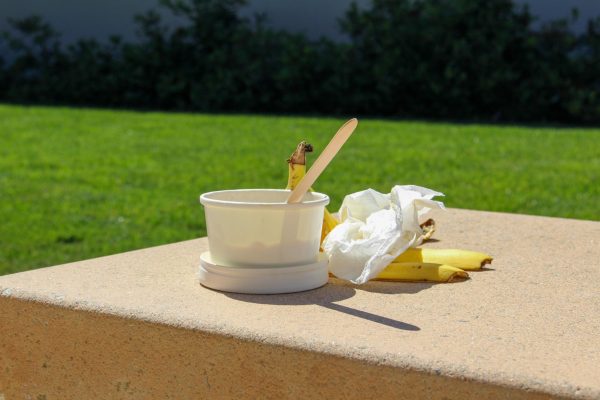
It’s a common sight every lunch: students dumping plastic salad containers, half-eaten bowls of minestrone soup and green-tinged banana peels all into one bin.
From there on, the trash is theoretically sorted at external facilities, but the outcome often depends on how diligently students sort their trash.. So, what actually happens to the trash once it’s in the wastebasket? The Talon embarked on a mission to find out.
Los Altos High School Trash Journey
The journey starts with Los Altos High School’s two-bin system: green bins are for compostables, and blue or black bins are for both trash and recyclables.
There are 84 total bins scattered across campus, categorized via the two-bin system, the efficacy of which hinges on student behavior. Even if a bin is labeled “compost” or “trash and recycling,” what actually ends up in each dumpster ultimately depends on whether items have been contaminated. For instance, if a compost bin appears to be filled with plastic wrappers or foil, it likely won’t be composted; similarly, compostable items like food scraps can end up in the landfill simply because they’re surrounded by trash.
“The previous administration had a goal to compost and recycle, but it hasn’t been successful because a lot of students either don’t know how or they just don’t want to do it,” facilities coordinator Bernardo Macedo said.
Once these bins fill up, custodians collect the waste and bring it to the 3-cubic-yard dumpsters at the front of campus: four for trash and recycling, and one for compost. The trash and recycling dumpsters are emptied daily, while the compost dumpster is emptied weekly.
After Campus
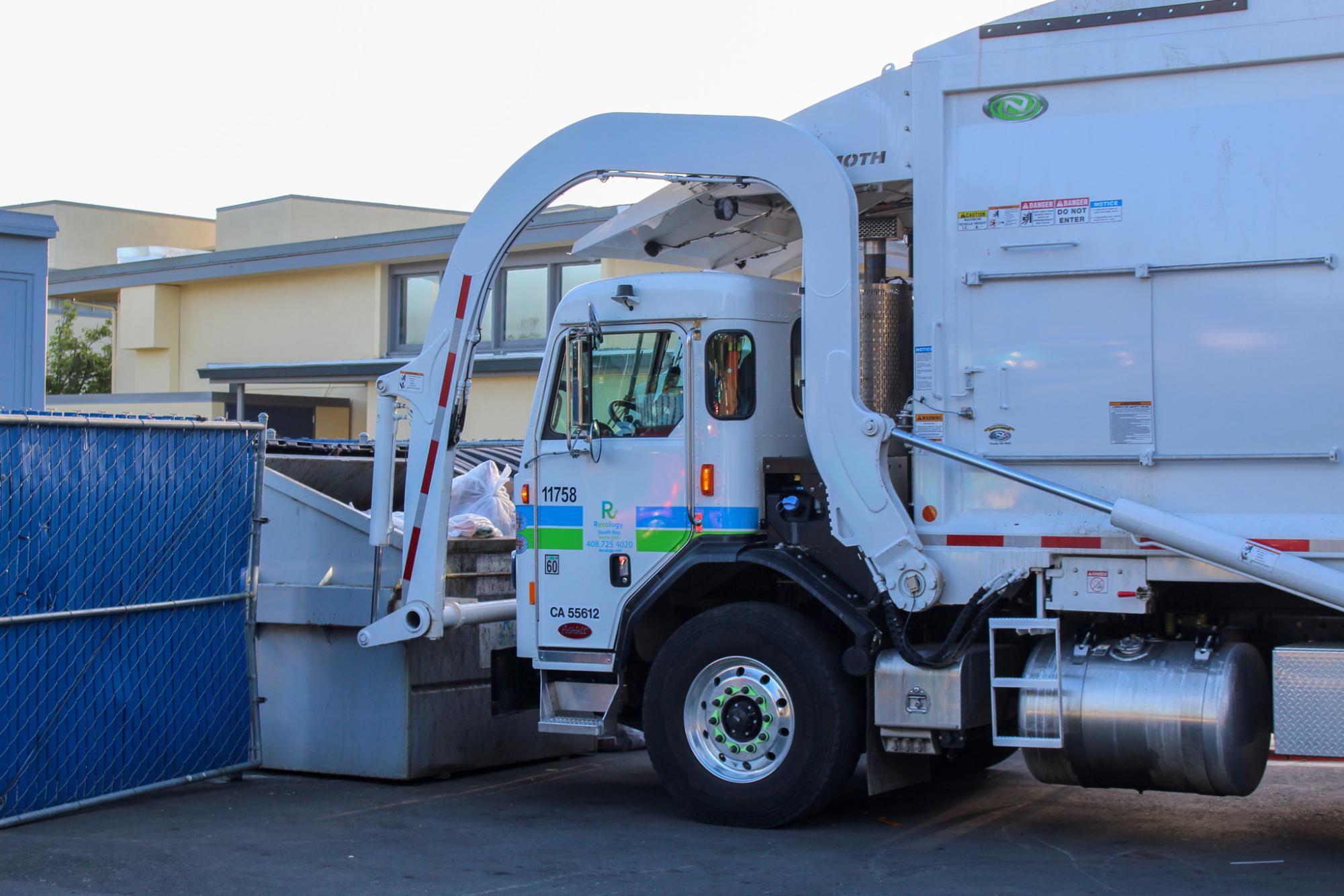
For compost, Recology — the waste management company responsible for hauling LAHS trash — takes it to dedicated compost facilities in either Vernalis or Gilroy. There, it’s broken down into soil amendments and compost fertilizer, later sold to farmers in Sonoma and Napa County.
Contents from the combined trash and recyclables dumpster, are hauled to the SMaRT Station Recycling Center in Sunnyvale, where trash and recyclables will be separated. The SMaRT Station, which started as a landfill 90 years ago, now serves as a processing center for recyclables and trash.
At the SMaRT station, the first step is the “tipping floor,” where very large items are removed. From there, the waste is pulled onto conveyor belts, where human sorters continue to remove bulky pieces. Then, the waste moves into large rotating trommels — large drums that tear open garbage bags and sort it into two size categories.
After the trommels, the recyclables are further sorted using magnets, disk screen sorters and an eddy current separator. These tools pull out steel and aluminum items, while paper and plastics are sorted by hand. Recovered recyclables are baled and sent to paper mills and manufacturers to be reused; whatever is not recovered at the end of the process is compressed into a 24-ton cube and sent to the landfill.
Local Problems
Even with LAHS’s sorting system and off-site processing at the SMaRT Station, much of the waste generated on campus still never gets recycled or composted. The biggest obstacle is contamination, when the wrong materials end up in the wrong bins.
“If we want to manage the trash as trash and the compost as compost, it would be the ideal thing to be doing,” LAHS custodian Martin Acosta said. “For students, that’s the biggest thing — being able to put the recycling and the compost in the specific bin.”
A single misplaced item can have much larger consequences than students realize: plastic wrappers tossed into compost bins can prevent food waste from becoming usable compost, and leftover food or liquids in recycling bins can contaminate otherwise recyclable materials.
“If there’s too much contamination — too many recyclables or too much trash — in the 3 cubic yard compost dumpster, they will send it to landfill,” Recology Waste Zero Manager Yvonne Lau said.
“We take contaminated compost to the garbage dumpster every day because it’s not very well sorted while it’s being disposed of by the students,” Acosta said.
Despite the school’s waste infrastructure, some students said the current system can make proper disposal confusing and inconvenient.
“I didn’t know there were different types of trash cans for different types of trash,” senior Neil Marwah said. “There are singular trash cans everywhere around campus.”
“I feel like all the pairs of green and blue bins are near the quad,” senior Zoe Cheng said. “If I’m in the back of the school, I have to go somewhere else to find a compost bin.”
A Broader Problem
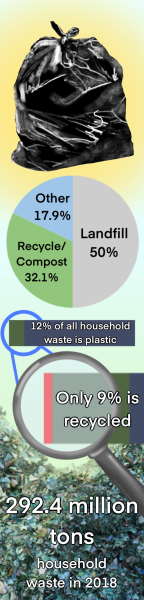
Issues with waste contamination impacting compost extend beyond LAHS. According to the Environmental Protection Agency, the U.S. generated 292.4 million tons of municipal solid waste in 2018. Of that waste, only 32.1% was recycled or composted, while roughly half ultimately ended up in landfills. Food waste alone made up over 24% of landfill waste, making it the largest category of waste sent to landfills nationwide.
Plastic remains another major challenge. Despite plastic accounting for more than 12% of all municipal solid waste in 2018, only about 9% was successfully recycled. For LAHS, many plastic products used on campus — including food wrappers and disposable packaging — are difficult or impossible to recycle because they contain multiple layers of materials or food contamination.
Some cafeteria products marketed as “sustainable” may also create confusion. SunCup juice boxes, for example, advertise recyclable cartons and compostable straws, but students may not know which waste bin these items belong in. When students guess incorrectly, those materials are likely discarded as landfill waste instead.
In addition to sorting trash, LAHS has also taken steps to reduce waste before it is even created.
“We used to use 1,000 plastic utensils every day,” Green Team parent liaison Sybil Cramer said. “The PTSA sustainability committee had a conversation with Food Services Coordinator Bryan Barnhardt, and LAHS switched to wooden compostable utensils.”
Still, the integrity of LAHS’s waste system largely depends on students’ abilities and willingness to sort their waste correctly from the start.
“I’ve seen people watch me put compostables into the green bin, but then proceed to throw it into the normal trash,” Zoe said. “I feel like there’s a certain level of disregard.”
In the end, the fate of LAHS’s waste often starts with the split-second choices students make every lunch break.