

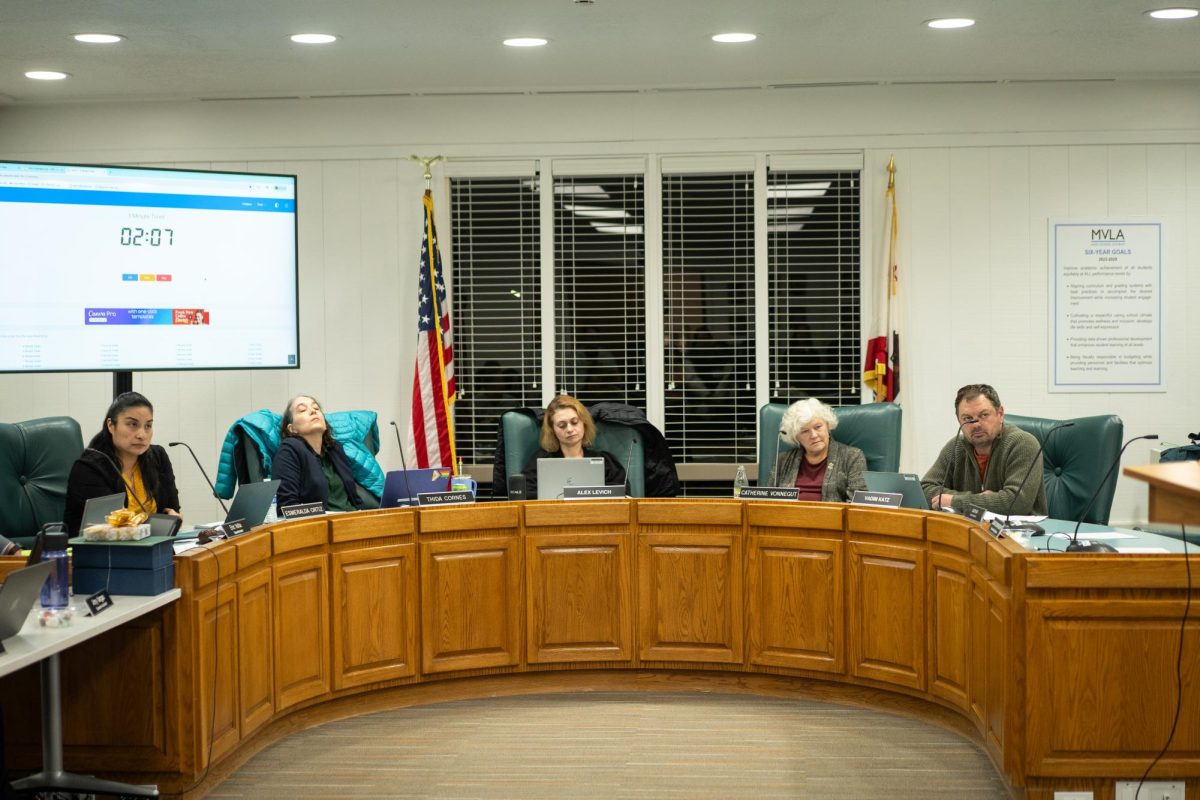
Ethnic Studies will become a required semester-long class starting next fall, following a 3–2 vote on Monday, Oct. 27, by the Mountain View-Los Altos Board of Trustees. This reverses the Board’s 2021 decision to be one of the few schools in California to offer a year-long Ethnic Studies course.
Beginning with the class of 2030 — next year’s incoming freshmen — students will take one semester of Ethnic Studies, with the other semester still to be determined.
Teachers now plan to revamp the curriculum, concentrating a year’s worth of material into a few months while maintaining the depth of each concept. For teachers, it’s now an additional burden for the next 10 months.
“We haven’t even had a chance to review what we’ll be able to cover,” Ethnic Studies teacher Candida Diaz said. “But our goal is to make sure students get the same learning experience and are prepared for 10th grade and onward.”
While curriculum can be condensed, Diaz said it may be difficult to establish connections between students, fundamental to grappling with complex and sensitive topics — such as identity, incarceration and colonialism.
“It’s not just the social studies skills,” Diaz said. “It’s also teaching students to be empathetic human beings. That’s getting lost in this part of the equation.”
With only half the time, Diaz said she is concerned that the same communities can’t be formed in the classroom, preventing the level of in-depth discussion that normally occurs.
Additionally, staffing and assignments will shift, according to Superintendent Eric Volta. The Board is still uncertain about staff layoffs.
Currently, Health is the only possible semester-long partner for Ethnic Studies. To protect teaching loads, some social studies teachers with the required credentials may teach Health or pilot a new freshman elective if there is enough student demand. Additionally, Volta said the social studies department may face reductions in terms of budget but the District’s priority is ensuring students get graduation credit after reducing a year-long course to a semester-long.
Perspectives on both keeping and changing the length of Ethnic Studies were shared at the Board’s Oct. 27 meeting prior to the decision.
Arguments for Semester-Long
Board Trustees Alex Levich, Vadim Katz and Catherine Vonnegut voted in favor of making Ethnic Studies a semester-long course.
Board Trustee Vadim Katz said the semester-long change restores schedule flexibility for freshmen while maintaining the state’s requirement of an Ethnic Studies course. Katz said the change “gives students an additional opportunity” to explore another class in ninth grade.
Katz also pointed to feedback from a District-wide survey, taken by students in May 2025, indicating support for the content of Ethnic Studies, but with a preference for a shorter format.
Today, Health is the district’s only other semester-long graduation requirement, so pairing it with Ethnic Studies simplifies freshman schedules. If the Board were to keep it as the only other choice, the decision would align with many other school districts in California including Palo Alto.
Volta emphasized the benefits of this decision — a scheduling boost by pairing Ethnic Studies with Health, an extra slot for freshmen to explore another class and relief for transfer and English-learner students. Volta said even if the District pilots a new social studies class in addition to Ethnic Studies, 100% of students must sign up for it to match the same number of sections as Ethnic Studies — a high bar for any single grade level. The semester model also helps transfer students and English learners avoid getting “burdened” by extra ethnic studies credits as they try to catch up, according to Volta.
Arguments for Year-Long
Board members Thida Cornes and Esmeralda Ortiz voted against Ethnic Studies becoming a semester-long course.
For those supporting a year-long course, Ethnic Studies’ deep dive into cultural analysis makes its length necessary to preserve. By examining complex social and historical issues, the course aims to encourage students to empathize with and understand diverse perspectives, Diaz said.
“When we surveyed the students, 76% said they learned about other cultures, perspectives and identities,” Board President Esmeralda Ortiz said.
Since the decision three years ago to make Ethnic Studies a mandatory year-long course, contention about its relevance has persisted. The survey highlighted the stakes of the Board decision, which was made after discussions that spanned three meetings. Pre-decision remarks included teacher and student concerns over content being lost due to a shorter curriculum.
“It inevitably sends a message that certain histories matter less and don’t deserve the full year than other history courses, which is indicative of what the course itself is trying to address,” Ortiz said.
Ortiz also said that shortening the course may jeopardize student outcomes, especially for those seeing their own identity in a history course for the first time.
“For our students of color, this is the first time they experience seeing themselves reflected within formal schooling,” Ortiz said. “I’ve seen how that positively influences their performance in not just that course, but across all their coursework.”
Teachers also fear that with less instructional time, students may be unprepared for their future social studies courses.
“The whole purpose of having a year-long class is to prepare our students for the rigor of their 10th-grade social studies classes,” Diaz said. “You jeopardize that goal when you reduce the course in half because, inevitably, there is less time to engage with the materials.”
Discussion over the Ethnic Studies budget and changing logistics continues at the next Board meeting, Nov. 17 at 7 p.m. at the District Office Board Room.