


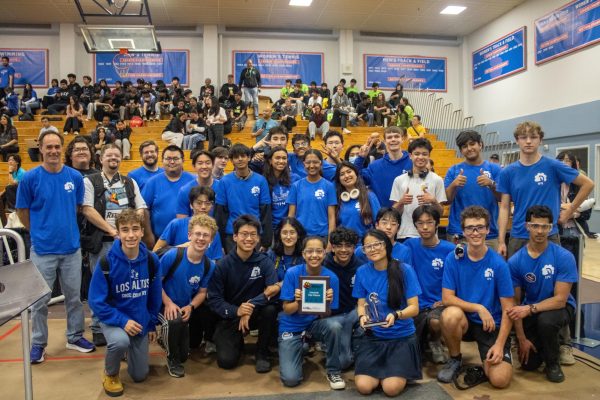
Thirty-four high school robotics teams flooded the stands all weekend long at the FIRST Robotics Competition (FRC) San Francisco District Event. Robotics Team 114 Eaglestrike’s 25-26 season robot “Inertia” fought its way to second place after two 13 hour days at their opening build-season competition, March 14 to 15.
“[In the finals], we were up against MadTown and Bread, two of the dominant FRC teams in the West Coast,” code lead junior Alan Chen said. “Everyone’s competing for second place here — second is basically first — and we did a lot better than expected.”
This year’s FRC game involves scoring points by launching foam balls or “fuel” into the scoring hub, goals active only during certain periods of the match. Robots alternate between “ferry” mode — moving fuel to their alliance’s side — and “shooting” mode — active scoring.
Matches occur in three-team alliances, with the top eight teams choosing their alliances at the start of the playoffs. Scouting — watching other robots to collect data on their performance — is an integral part of alliance formation.
“Numbers only tell you so much of the picture,” scouting lead senior Edward Liu said. “Qualitative data helps you get more information on little things, like driver skill and mechanism build quality, that affect the game a lot.”
In preliminary rounds, scouter junior Emma Lu noticed an opposing robot was limited to shooting from one part of the field and notified team captain senior Zoe Cheng. The team shifted defensive strategies mid-match, allowing them to cut off the opposing alliance’s scoring and take the win.
Within alliances, a common strategy is for two teams’ robots to focus on scoring, while the other works on ferrying and defense. However, this means robots easily get damaged from collisions or other technical difficulties. That’s when the pit crew — composed of about five people — come in to make adjustments.
“In about 30 minutes, we fix anything that breaks,” pit crew sophomore Ethan Chiang said. “Anything that needs preparation for the upcoming match, pit crew will take care of it.”
From charging batteries to revamping entire systems, the pit crew has anywhere from 15 minutes to an hour to make sure the robot is up and running. Considering the resource and time constraints, pit crew say they have to think creatively to simplify solutions.
“The idea is to fix a feature or disable it,” technician senior Arush Garg said. “When we’re fixing on the go, we have no time to do the standard process for writing code, reviewing it and going through different branches.”
With only a few days of code testing and driver practice before the competition, Team 114 bumped into several issues. For one, the robot consistently stayed in ferrying mode when the driver tried to switch it to shooting mode due to an autonomous zoning error. Since there was no time to debug, the pit crew entirely disabled the autonomous triggers and gave the operator the entire responsibility of switching modes.
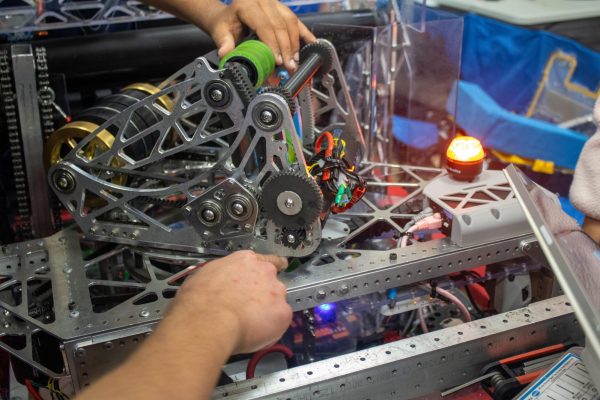
Another issue the pit crew encountered was fuel getting stuck in the intake and not getting through the channel into the shooter. To combat this, they added a rubber band agitator to hit the balls harder, adding spin and repairing the system.
“It was a minor fix that led to major improvement,” pit crew sophomore Ethan Chiang said. “But it’s a huge adjustment done right before our playoff matches started.”
That repair was advised by mentor Ryan Cardona ‘18, who used to be Team 114’s electrical lead. While Cardona assisted from off the field, Team 114 holds a “no mentors on the field” philosophy, where students plan, lead and carry out all improvements.
“Obviously, we want to win, but since we are a school team, our point is to teach people how to do engineering,” Zoe said. “Having students be super involved at every level is the best way to do that.”
Team 114’s next competition is the California District Central Valley Event from March 27 to 29 in Clovis.