

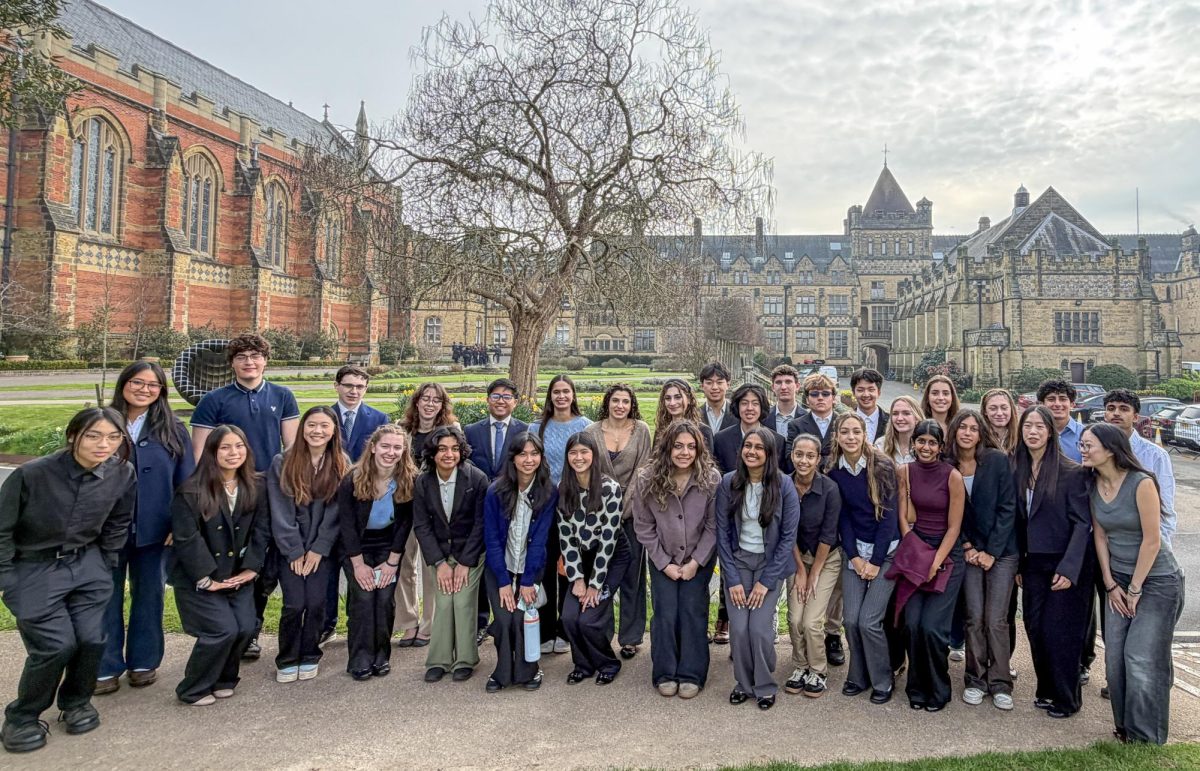
Students from Advanced Science Investigation (ASI) took their research across the world, traveling to London to present their yearlong research projects at a science symposium. Taking place at the Tonbridge School, students shared their findings with British students and researchers.
Accompanied by science teachers Elizabeth Pyle, Daniella Duran and Allysa Saylor, the weeklong trip from Feb. 28 to March 7 allowed students to present their research findings, hear from science professionals and explore London. The symposium has become a tradition for ASI — the class visited London twice before in 2020 and 2023.
“It was really amazing to get them to see work with their peers and exchange ideas and get to know each other,” Pyle said. “Even though they’re from across the world, they’re all top performing science kids internationally.”
Every student presented a poster highlighting their research, ranging from reducing inefficiency in LLMs to exploring the effects of vitamins on lung cancer. According to students who went on the trip, much of the British student research was more literature review than data collection.

“We’re lucky enough to have a really cool lab at our school where we’re able to conduct these experiments ourselves,” senior Theo Santos said. “Obviously, that’s not the case for all schools, but it was really cool to see what they’ve been accomplishing even without working in a lab.”
Some students, including Theo, were selected by the ASI teachers to give oral presentations on their research to audiences of 20-40 Tonbridge students, ending with a Q&A session.
“It was nice to see how much [ASI teacher Tory Johnson] had prepared us for that moment,” Theo said. “We could explain what our results were and share what we’ve been doing this entire year.”
Besides their own research, students listened to keynote presentations by Tonbridge alumni on topics ranging from drug discovery to oil and gas energy needs.
“It was really great for them to hear different ideas and research from their peers and experts in their field,” Pyle said. “It was also incredible to see them really immerse themselves in British culture.”

Outside the symposium, the class spent much of their time sightseeing. The group visited the Tower of London, Buckingham Palace, Big Ben and took a ride down the River Thames.
While some activities immersed students in London’s culture, others were science related. During a visit to Stonehedge, the class participated in an activity where they moved heavy hay bales across a field using basic physics principles. They also toured multiple museums, including the National Science History Museum and Museum of Computing.
Students highlighted how the trip brought them closer to their peers.
“The best part of the trip was the experience of being with people that you didn’t know as closely before,” senior Jason Byrne said. “You got to see their passion for their project and get to know them as a person.”
Looking forward, Pyle hopes to make the trip more frequent, either annually or biennially, rather than every three years.
“Every year might be a bit ambitious, but the kids enjoy it so much,” Pyle said. “I do think it makes more sense to make it every other year, instead of every three, so more kids get the opportunity.”