

Last semester, The Talon was proud of improving the representation of diverse groups and identities in our coverage. For the first time, our source diversity nearly matched the student and staff demographics of Los Altos High School. This was the result of concrete goals which brought us a step closer towards our mission of giving everyone on campus a voice. But we still have work to do.
This semester, our audit regressed in several areas of representation. We’re holding ourselves accountable for our shortcomings, and commit to maintain diversity of our sources and newsroom.
We can’t keep setting goals and not following through. It fails to build deeper connections with students in communities we’ve historically underrepresented. We’re not reporting for the sole purpose of equalizing a graph; we’re doing it to share the wide range of stories of our community. Knowing the people we’re covering is a strong first step toward that.
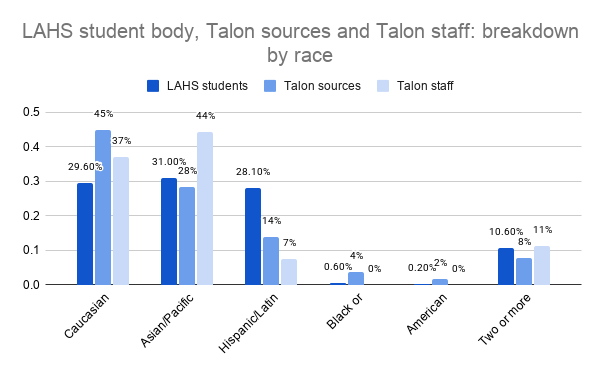
Breakdown by Race
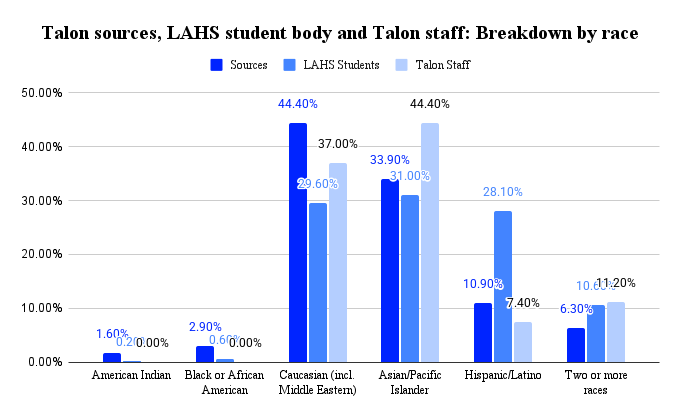
This semester’s numbers on racial diversity point back to old habits, such as defaulting to Caucasian and Asian voices. While these groups are about 59% of LAHS students (29% Caucasian, 30% Asian), they made up 78% of our sources. Consequently, our coverage severely underrepresented Hispanic and Latino students, who make up 28% of the school but only 11% of our sources.
The Talon’s staff demographics may contribute to this pattern. 44% of The Talon’s reporters identify as Asian, and 37% Caucasian. When most editors and writers make up two demographics, our sources, often within our social circles, end up in the same overrepresented groups, too.
Sometimes, talking to those sources is inevitable. Club leaders, team captains and staff members — 64% being Caucasian — are often target sources when we’re covering school events and sports. When we fall into this set routine, we tend to overrepresent such demographics.
Clearly, the stories we cover matter. With coverage of ELD, Black Student Union and undocumented families last spring, we increased our proportion of Hispanic/Latino sources last school year from 8% to 21%. Though it’s still lower than school data, it’s much closer than years prior. Without stories that actively seek out the unheard voices, our representation dropped immediately back to 11%.
Breakdown by Gender
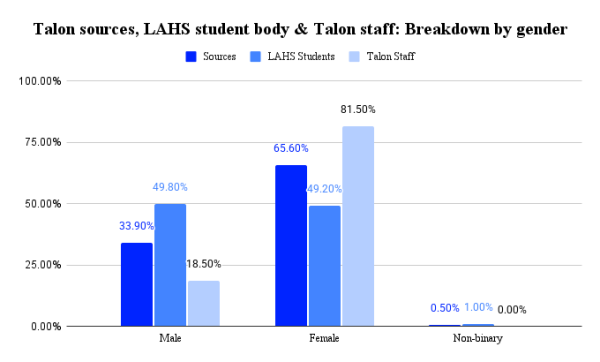
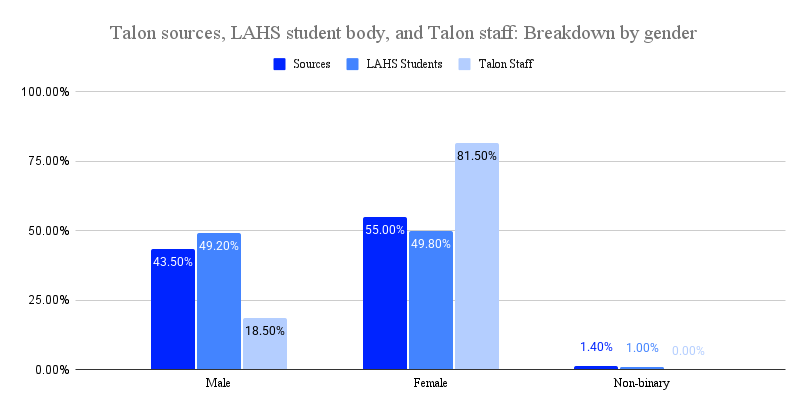
This semester, 66% of our sources were female and 34% were male. Female sources significantly increased from last semester (55%) and overrepresent female students at LAHS (49%). The Talon’s newsroom partially explains this disparity, with 81.5% of our staff identifying as female, and only 18.5% male.
But this difference isn’t just rooted in The Talon’s staff demographics — it’s also due to the topics and feature subjects of this year’s stories. Girls sports saw more success this fall, from college recruitments to historic postseason results. On the Homecoming Court, 15 out of 20 members were female. These events were major portions of our coverage this semester, with 70% of all videos being Homecoming Court features and roughly 50% of sports articles covering CCS-qualifying teams.
Still, The Talon can make a more conscious effort to balance out our sources. We’ll continue to push our newsroom to source proportionally by gender when possible.
Breakdown by Grade Level
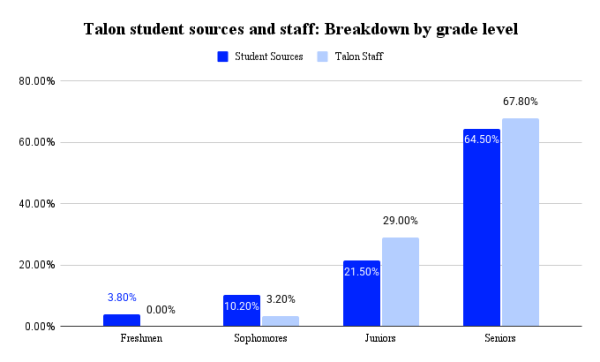
When it comes to grade-level representation, our coverage this semester was clearly senior-heavy. Of all interview subjects, 64.5% were seniors, 21.5% juniors, 10% sophomores and just 4% freshmen.
The interviewee demographics correlate with The Talon’s own staff, where 68% of members are seniors, 29% juniors and 3% sophomores — consistent with the race and gender breakdowns. This is in part due to the Journalism One prerequisite.
Additionally, upperclassmen typically occupy higher leadership positions on campus — senior captains and club presidents are often our go-to sources. As a result, freshmen and sophomores are underrepresented in our reporting.
A higher proportion of upperclassmen sources is reasonable, especially when LAHS dedicates special events and recognition to seniors, such as Homecoming Court and sports senior nights. Covering these events, our source distribution becomes naturally skewed. It’s not necessarily an issue itself — almost all of us will be seniors eventually — however, having 64.5% senior sources is still overrepresentation.
If The Talon aims to represent all students, we must be more intentional about seeking out younger voices, even if that means interviewing a club’s newcomers or finding stories within a JV team.
What’s Next?
The Talon needs to do better. With course selection coming up, we’ll encourage current freshmen students in Survey and AVID to join Journalism One — Talon’s feeder class — to involve a wider grade and demographic range on our staff.
Additionally, we’ll search beyond the easy stories: those told time and time again, such as our annual Día de los Muertos celebrations and coverage of ASB tournaments. We’ll cover the whole community — especially those often unheard, such as features on LAHS’ maintenance crew and Mr. Rojas last year.
As a class, we’ll spend our final exam period setting concrete goals for a more accurate representation of our school’s community — and we’ll update you with a follow-up editorial. We’ll review our source demographics more frequently, and every print issue next year will include that cycle’s own diversity audit.

Especially in the second semester, these changes ensures we’re catching and addressing disparities as they occur instead of forgetting our goals over summer break. In our newsroom, we’ll require that each writer be conscious of every story’s sourcing, introducing more personal accountability.
The Talon is working to hold ourselves accountable, and we hope that our readers will do the same.