

Every semester, The Talon asks ourselves the same question: whose voices are making it into our stories, and whose are not? Despite this year marking our third year of auditing the diversity of our sources, we faced familiar concerns.
The findings of our audit remind us that providing the best possible coverage means intentional effort. When we aren’t actively considering what stories we tell and the perspectives to include, our sourcing fails to represent the entire LAHS community.
The Talon aims to be transparent in both our shortcomings and how we plan to improve for the future. We hope to eventually be a newspaper that fully and fairly represents the voices and experiences of all of you.
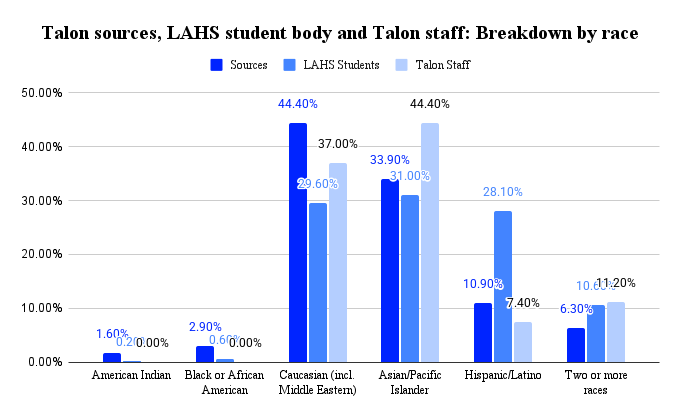
Breakdown by race
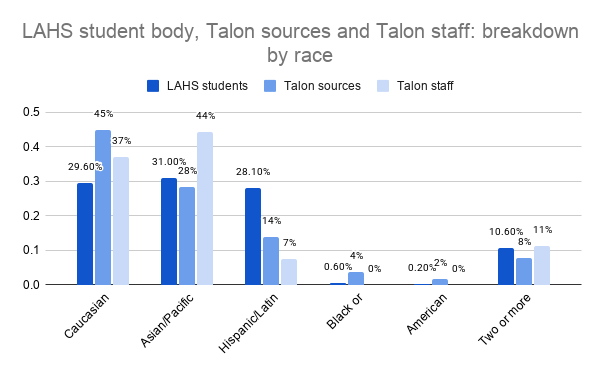
While Asian and Black sources were roughly proportional to the student population, Hispanic students remained significantly underrepresented. Our Hispanic sources accounted for only 13.7%, despite making up 27.3% of the LAHS student body. Alongside the loss of the Hispanic voice, we saw an overrepresentation of Caucasian sources, accounting for 45% of our sources, as compared to the 31.1% Caucasian student population.
Unfortunately, this imbalance is nothing new. Last year’s second-semester diversity audit was the closest to mirroring that of the student body, but every other audit has seen this same issue.
These numbers matter. The Talon strives to be a publication that makes every single student feel seen, but when we fail to cover huge portions of our campus time and time again, we fail those students.
Part of the problem begins with our newsroom itself, where the majority of our staff identify as White and Asian, making certain communities and their stories less visible to us. Still, this is no excuse: we have a responsibility as journalists to make a genuine effort to represent our community as accurately as we know how.
Looking forward, during the next school year, we want to be more intentional about sourcing for every story. It’s not about covering minority groups simply for being minorities — but rather actively seeking out the stories that don’t fall into our lap and may take a little digging.
We plan to accomplish this mainly through better enforcement of the beat system: ensuring writers covering beats such as AVID and identity clubs such as LSU are routinely searching for new voices. We will also use our class period to teach writers how to diversify their sources and push them to engage with communities they may be unfamiliar with. Finally, we will monitor our diversity audit throughout the semester to improve in tandem with our issues, rather than waiting until the end of the year to make adjustments.
Breakdown by gender
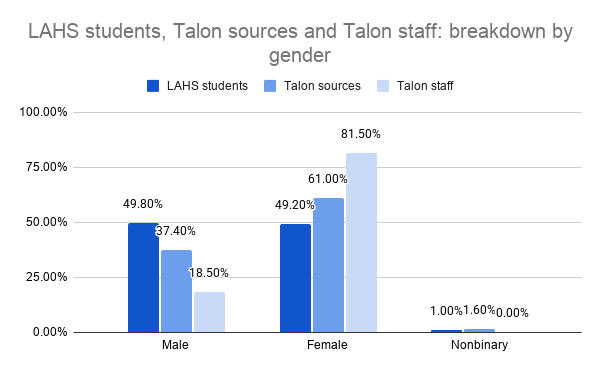
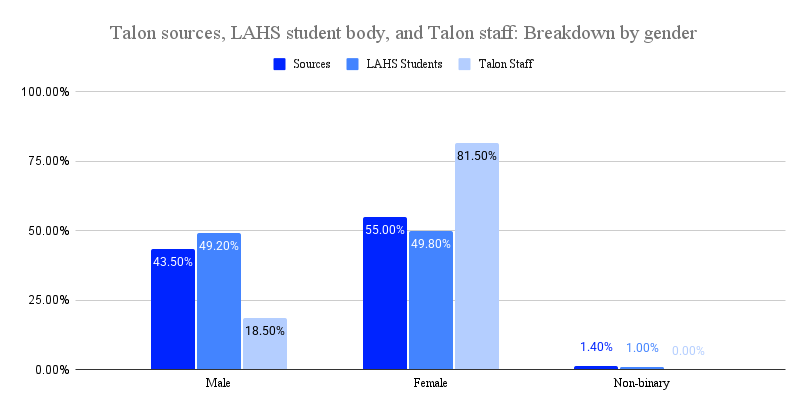
Gender disparity in our sources showed a heavy skew towards female-identifying sources, with 37.4% male sources, 61% female sources and 1.6% non-binary sources.
Among other issues, our coverage of senior superlatives worsened the numbers, with 13 out of 16 of the seniors identifying as female. The shift can also be attributed to The Talon’s majority female staff, which has historically resulted in a similar gender discrepancy. However, no matter who our staff is, we want to hold ourselves accountable and will push our writers to always choose sources unbiasedly.
Breakdown by grade
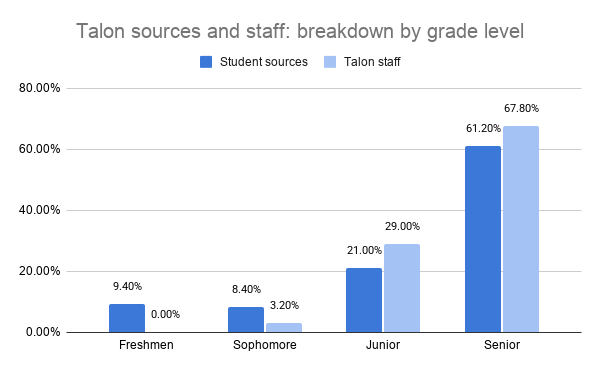
Our grade level representation continued from last semester, skewing towards seniors. In fact, underclassmen accounted for less than 20% of our sources, with 9.4% and 8.4% for freshman and sophomore sources, respectively, compared to the 21% junior and largely 61.2% senior sources.
Similarly to the gender breakdown, the grade disparity likely stems from our staff demographics, with seniors accounting for 67.8% of The Talon staff. The disparity was also exacerbated by the lack of integration of the Journalism One class into The Talon, which has historically helped us shift the balance towards underclassmen during the second semester.
Some overrepresentation of seniors was expected this semester, especially given our Senior Magazine, which we publish every spring and purposefully highlights senior voices. Upperclassmen also typically hold more leadership positions across campus, which can make them more suitable sources for many articles, further contributing to their higher proportion.
Still, it’s unacceptable for a quarter of the student body to make up more than half of our student sources. If we are committed to highlighting all voices, we must intentionally seek underclassmen stories that may not be as obvious to find. Whether that means improving our beat system or increasing collaboration with Journalism One earlier in the year, we must make a greater effort to ensure all grade levels feel recognized in our paper.
Looking forward
Every student’s story matters to us. But it’s not fair for The Talon to keep making promises that we don’t keep and fall into the same cycle of covering only the “easy” stories.
In the fall, we expect to have a significantly smaller staff size — half what we had this semester. This means less is more: rather than chasing every story that we find, we must be intentional about finding those that represent the entire LAHS community. Every source, interview and article will carry that much more weight.
Clearly, improving the diversity of our coverage does not come in a single push or initiative, but takes consistent effort. It means actively looking at our biases and correcting them, reflecting on our problem areas and continuing to seek stories from our overlooked communities.
There is a lot of work to be done, but better representing our community remains a top priority for The Talon.