

Over the summer, special education teacher Dalia Gamez taught a class helping students transition from middle school to high school. Every time she walked into the classroom, she was met with freshly-copied papers and a sharpened pencil.
“All that extra work was done by [Kao Moua],” Gamez said. “I love her with all of my heart, and I will always remember her.”
Kao Moua is one of Los Altos High School’s 14 instructional aides (IAs) on campus. During the school year, most IAs work full-time, jumping between multiple classrooms, with a primary goal of supporting students with Individualized Education Plans (IEPs).
“I’m a people person, I think all the IAs are,” IA Christine Antonakoppoulos said. “This brings us joy.”
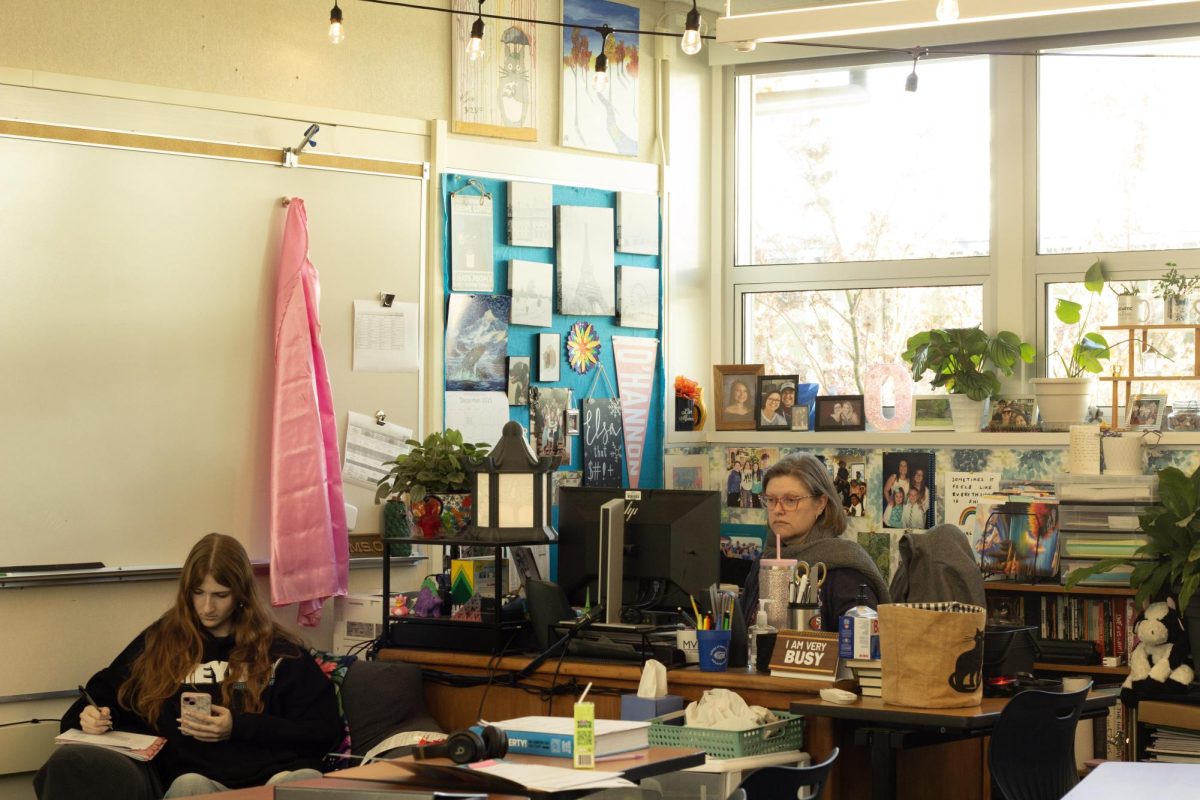
IAs learn how teachers manage their classrooms and familiarize themselves with the content students are learning to best support teachers. When class is in session, they typically sit in the back of the room, ready to provide one-on-one assistance to any students struggling or off task.
“They’re able to help the teacher identify the needs of students that maybe aren’t seen,” special education department coordinator Amy O’Hayer said.
O’Hayer largely facilitates placing IAs into classrooms. IAs follow fixed schedules, dividing their time between small-group academic classes, such as special education classes, that require an IA and general education classes. However, their schedules may change later in the year if they find that one class needs more support than another––something O’Hayer keeps track of through check-ins with teachers and departments.
“The best part of my job is seeing students succeed after I help them,” IA Freiwot Zeray said. “It’s challenging sometimes, but we just take it easy and help however we can.”
For some students, learning to welcome this help is not always immediate. Sophomore Sophia Gonzales said that she was reluctant to turn to instructional aides during her freshman year, despite recommendations from her teachers.
“I didn’t want to be seen as different,” Sophia said. “But I knew that they were always ready to help me.”
Yet as her classes became more challenging, she decided to give them a chance. Now, Sophia is supported by multiple IAs that she can work with during her core classes, ACT and after school.
“Now that I’m moving forward with these aides, I feel so much more supported ,” Sophia said. “They make high school a better experience.”
Nonetheless, the contributions of IAs often go unnoticed.
“A big reason why we receive less recognition is that we’re not ultimately responsible for the students,” Antonakopoulos said. “But, I think it would be really nice to include the IAs when teachers have back-to-school nights.”
Despite this limited recognition, the presence of IAs in classrooms has grown in recent years. As more students with IEPs select LAHS’s co-teaching courses––where two teachers work together, taking turns instructing students and helping from the sidelines––the number of small academic group classes has decreased. As a result, IAs spend more time in general education classes than before.
“If you have 34 students, you can’t always get to every single one individually,” O’Hayer said. “Having another adult in the room can help gauge the energy of the students.”
This additional support has not gone unnoticed by general education teachers.
“Instructional aides are amazing,” Forensics teacher Lisa Bolton said. “They can give support to students during class time instead of students having to come after class to get more help.”
For IAs, this work carries its own sense of fulfillment.
“Our business here is the students,” Antonakopoulos said. “They will always be our biggest and most important customers.”