


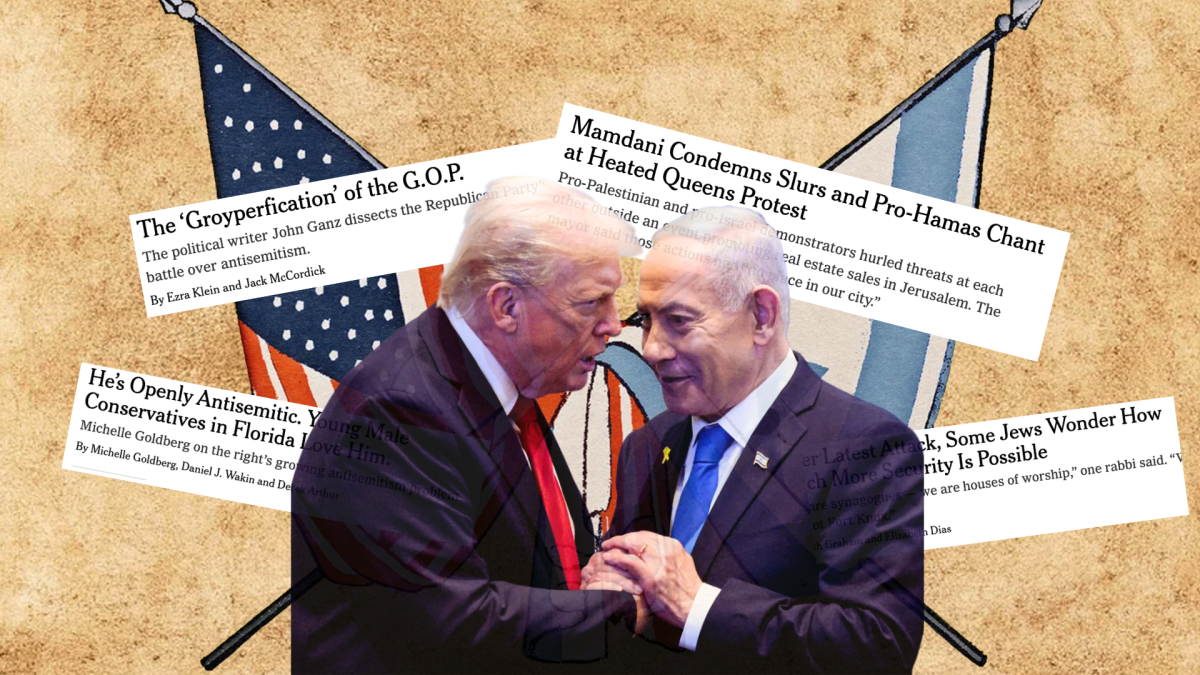
In an era of political polarization, there seems to be one thing that the right and left can agree on: perpetuating Jewish hatred.
The grounds for antisemitism
Over the past decade, political polarization has expanded, driving the nation apart. As more issues become considered politically controversial, less progress is made. Fundamental problems like inequality or unaffordable healthcare have become a matter of which party can undermine the other’s arguments rather than actual action.
Yet somehow, one topic has created agreement: blaming the Israeli government.
I first noticed this movement on social media, championed by far-right influencers like Nick Fuentes — someone I’d always understood to be a right-wing white supremacist. Despite that, his content on my feed represented a reasonable persona, emphasizing the humanity of genocide victims in Gaza and criticizing the U.S. government for funding Israel’s violence. His criticisms sounded identical to many on the left, condemning Israel’s bombings in the West Bank.
This change in perspective felt promising, suggesting an end to our country’s growing polarization.
The dialogue even seemed to be productive. From different sides of the political spectrum, there emerged widespread criticisms of the Israeli lobby’s role in the U.S.’s political corruption. Many pointed out the outsized influence of the American Israel Public Affairs Committee (AIPAC) — which counts as the top contributor for 15% of the current U.S. Congress — or the connection that many billionaires have with Israel. For example, people outwardly criticize the CEO of Palantir Technologies, Alexander Carp, for directly supporting the Israeli government as well as his company’s role in mass surveillance and facilitating violence across the world.
Same words, different mouths
On the surface, it seems like we are making progress on issues, starting to bridge the gap of polarization. And yet, these criticisms of concentrated power and worsening inequality have devolved back to old habits: scapegoating as a way of pacifying true action.
Many protesters and activists of the far left outwardly support Hamas — a terrorist organization that commits violence against the Israeli people. This support has blended activism with militant violence, targeting Jewish people. Just last year, a far-left activist Elias Rodriguez shot and killed two staffers for the Israeli embassy.
Meanwhile, members of the far right have unified under the guise of “America first” — a movement centered around White Christian nationalism. Initially framed as criticism of our government’s spending, anti-Israeli sentiments have rapidly transformed into a hate movement, blaming everything as a result of Jewish control. This has quickly fueled Neo-Nazi violence. This year, Ariel Collazo Ramos was sentenced to five years in prison after sending threats to a Jewish North Carolina senator and a Macon rabbi.
We fail to separate the government from the people they represent.
While our country encounters legitimate issues, the same scapegoating of Jewish people that the Germans relied on as their country’s economy collapsed in the 1920s seems to be reflected in everyday political rhetoric.
Today, that rhetoric is rapidly reaching new audiences, with social media being inundated with Neo-Nazi propaganda and straight up Holocaust denial. Worst of all, these hateful sentiments are being promoted by influential figures across the internet. Earlier this year, influencers like Andrew Tate, Nick Fuentes, Clavicular, Sneako, Myron Gaines and Justin Waller all gathered in a club singing “Heil Hitler” by Kanye West. Antisemitism is reaching young and impressionable audiences, expanding through casual racism masked as memes on social media.
Craving catharsis
Both sides of the aisle can unite under the same frustrations: one in four people don’t have enough money to eat on a regular basis, while billionaire wealth is historically high.
The election of populist leaders shows just how ingrained this inequality has become in the American consciousness. The victories of President Donald Trump on the right and New York City Mayor Zohran Mamdani on the left, both running on platforms criticizing the elite and a broken status quo, make it clear that America wants and needs change.
Aristotle described tragedy as producing catharsis by allowing audiences to experience fear and pity within the safety of the theater, only to realize it was purely second-hand.
Today, social media replicates that structure: we experience outrage and empathy at a distance, and that emotional release substitutes for action. By engaging with politics without action from the safety of our devices, we are free from accountability — choosing whichever side is convenient and appealing. Antisemitism just happens to be a blanket blame for everyday issues we face.
Hatred will always manifest itself in different forms, but it only divides the people. Our obsession with discrimination from racism to sexism is by design. It creates infighting to prevent actual collaboration to address systemic problems.
For decades, elites have exerted overwhelming influence over a government that affects our everyday lives. Lobbying has distorted American politics, giving power to those already at the top and blurring the difference between parties. It feels as though whoever is elected — Democrat or Republican — can have their agenda bought off by corporations. Our polarization has only further demobilized pushback against this broken system. Rather than holding our politicians accountable, we turn on one another — scapegoating marginalized communities while the powerful continue to operate unchecked.
Building an America worth living in demands more than outrage or moral high horsing. It requires informed citizens willing to engage across the aisle, holding leaders accountable without abandoning democratic norms and transforming frustration into civic participation.