

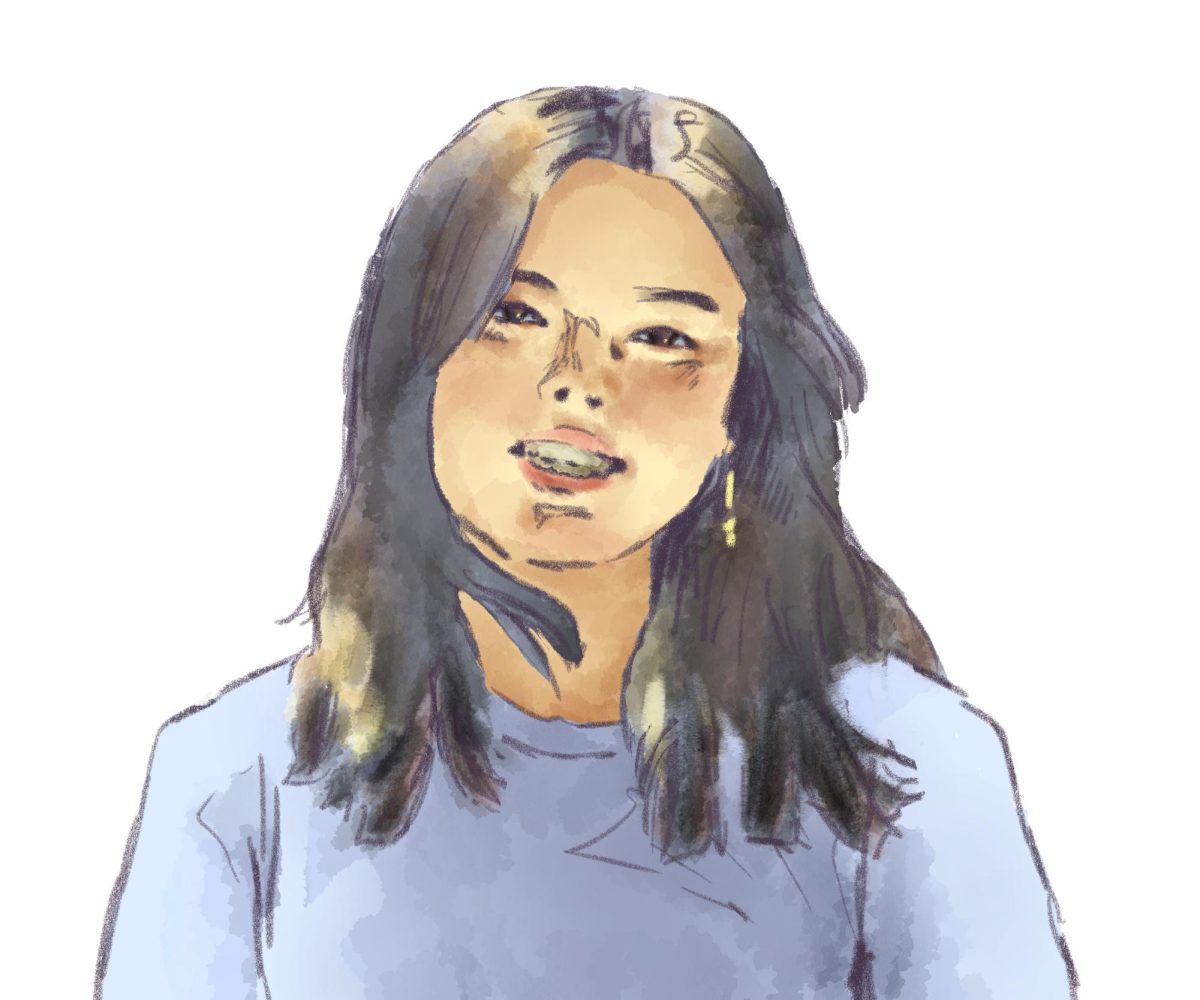
Despite creating art since age three, I always failed to believe in “happy accidents” (sorry Bob Ross). I couldn’t stand a line that was slightly off, or a color that didn’t match the exact shade I’d envisioned.
For a while, that’s how I thought my life was supposed to work, too.
I was going to be a psychiatrist. It was a fixed destination, and I’d let myself gravitate toward it for as long as I needed, trusting I’d arrive eventually. In a way, it was comforting to believe that my purpose in life was something I could just choose once and then latch onto for the entirety of my existence.
But somewhere along my trajectory, I unexpectedly fell in love with physics. I didn’t realize this through a sudden epiphany; it was more a gradual awareness of how its laws could so quietly yet bizarrely reshape my worldview. The more I leaned into my fascination with the subject, the more I felt pulled towards the possibility of a different career. I couldn’t ignore it — and that scared me. Diverging from my original interest in psychiatry felt more like losing my bearings than discovering my true passion.
It was after I learned about time dilation — the concept that time stretches and bends depending on your location and speed — that I came to terms with a freeing idea: people can experience time differently, and all accounts of it remain valid in their respective frames of reference.
If even a seemingly unforgiving constant like time can be so malleable, maybe the life purpose I chose six years ago shouldn’t be a single, rigid pathway I need to follow as closely as possible. As I ruminated on this, I started to believe that letting go of the psychiatrist dream wasn’t steering off course but simply stepping into a different frame of reference.
With the release of my former dream came the realization that sometimes, to grow into the next version of yourself, you have to let go of the person you once insisted on being and the narrow ideals once associated with them.
So I finally let myself love the stars.
In the past year, I learned that everything we observe through telescopes has already happened because light takes time to reach us. I find that a little unsettling, but also kind of beautiful, because it means the present is the only time we can feel, not just observe.
Throughout high school, I treated my life as a series of moments to savor later — as soon as the stress had passed, after I had been “productive” enough to deserve happiness. That’s my biggest regret. If I could re-live the past few years (which, unfortunately, relativity does not allow), I wouldn’t view my life through the delayed lens of a telescope, hoping to come across a future that will never quite arrive. I would learn to live in the middle of all the chaos.
So here I am, at the edge of whatever comes next, a little less certain but excited to face all the unknowns. If physics has taught me anything, it’s that time is not as absolute as it feels — and neither are the lines we draw for ourselves.